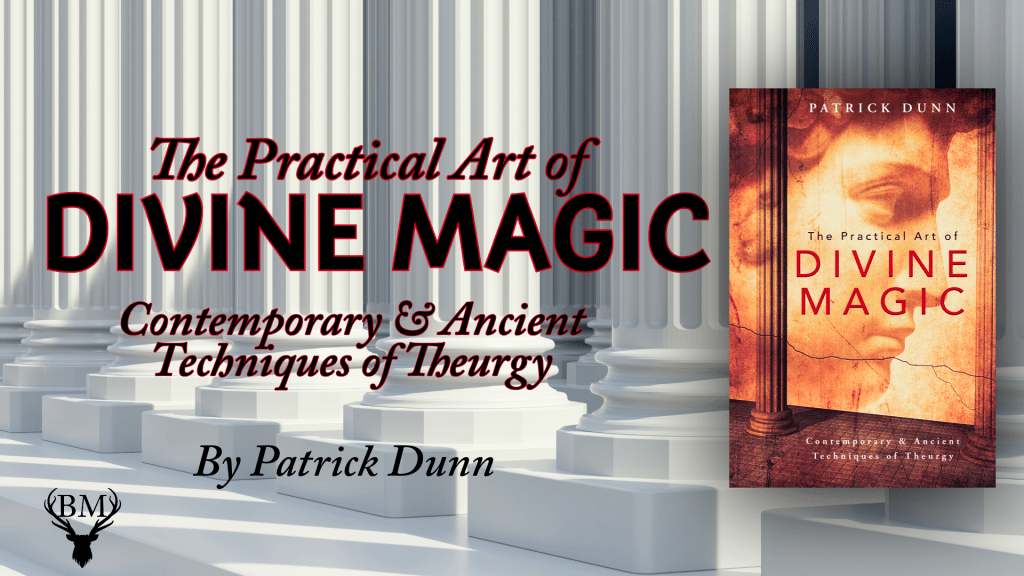
After reading Theurgy: Seven Approaches to Divine Connection, an anthology published by Llewellyn (which I reviewed here), I felt inspired to pick up a copy of The Practical Art of Divine Magic: Contemporary & Ancient Techniques of Theurgy to read next. Patrick Dunn, the author, also had a piece in the anthology so it seemed like a good next step in my magical development. As my personal practice has been more heavily inspired lately by forging a deeper understanding of the Witch Goddess, I felt that a progressively more in-depth book on Theurgy would be just what I needed to accomplish this, and this book most certainly delivered.
The first few chapters deal quite a bit with the history of Theurgy, and since I had already been exposed to its beginnings in the anthology, many of the things discussed still felt familiar. The real work though starts to present itself in chapter four. This is where the mental preparation begins, and in the subsequent chapters, we are given tools and techniques for making offerings and performing sacrifices (not the human kind) for the gods. I found it particularly lovely that each of the exercises presented in the earlier chapters could be pieced together to create an entire ritual designed to commune, connect, and work with whichever manifestation of the Divine you are aligning with.
I really valued the simplicity of Duncan’s libation exercise— “breaking bread” with the gods is certainly a delightful way to build a relationship with them, and perhaps the reason many Witches, myself included, tend to get a bit lazy with this is because we assume that an act of libation needs to be some large, grandiose event. That’s just not necessarily the case. Consider the book’s example libation to pan:
Step 1: Have a glass of liquid, preferably something you like to drink.
Step 2: Pour a small amount out onto the ground or into a libation dish. Imagine the essence of this libation expanding throughout the local space, becoming available to the god.
Step 3: Pray, beginning with “To you,” and the name of the god. Feel free to use this prayer of Socrates as a model:
Beloved Pan, and all ye other gods who haunt this place, give me beauty in the inward soul; and may the outward and inward man be at one. May I reckon the wise to be the wealthy, and may I have such a quantity of gold as a temperate man and he only can bear and carry.
Socrates directs this prayer to Pan, a god of nature, which is not insignificant, but you could direct the same prayer to any god of your liking.
Step 4: Drink. Moderately, please, if you are drinking alcohol. (Duncan)
And viola! A simple, effective libation that can be performed, well, anywhere. It’s easy enough for a silent moment of communion with my gods before starting my day, or ending it, while still being effective enough to incorporate into the conclusion of more elaborate rites and rituals.
The chapter on oracles was incredible—so much information on how to perform divination, both ancient and modern, in conjunction with the gods. Scrying, clairvoyance, and a technique I’ve never heard of called overshadowing are all presented in a clear, easy to follow format, followed by an extensive selection of various methods of other forms of deviation.
I found the chapter on the Daimon to be the most valuable. The concept of the Daimon has fascinated me for quite some time, but it’s rarely discussed in most of the mainstream literature on the occult. To find a whole chapter dedicated to it was refreshing. While there is a good deal of history on the Daimon included in this chapter, the best part is the modernized (meaning it’s actually workable to the average person) ritual to attach a familiar daimon to oneself. I am just about done gathering all the tools needed to perform this ritual and cannot wait to do it. (The myrrh ink threw me for a loop!)
This book was truly wonderful and I really felt that reading it helped me influence my personal practice. Not many books do that, but Patrick has done a lovely job of teaching here how to incorporate ancient magical traditions into modern practice.
About the Author
Patrick Dunn (Chicago, IL) is a poet, linguist, Pagan, and a university English professor with a PhD in modern literature and language. His understanding of semiotics and the study of symbols arise from his training in linguistics and literary theory. He has practiced magic since childhood.
Book Information
- The Practical Art of Divine Magic by Patrick Duncan
- Publisher: Llewellyn
- Publication Date: August 2015
- Dimensions: 6×9
- Page Count: 336
- Purchase link.
 Blake Malliway
Leave a comment