I remember meeting Raven Grimassi for the first time at one of those new age conventions when I was around twenty, although I had no idea I was actually speaking to him until some time after our conversation had ended. I had picked up a book at one of the booths and struck up a lovely conversation with a man there about all things magical. We talked for what seemed like hours, when in reality it was probably about half an hour, maybe 45 minutes. I never got his name, but when I got back to my car and cracked open my new book, Spirit of the Witch, I saw his face plastered right there on the author page! Who knew that I had just had a whole conversation with none other than Raven himself?!
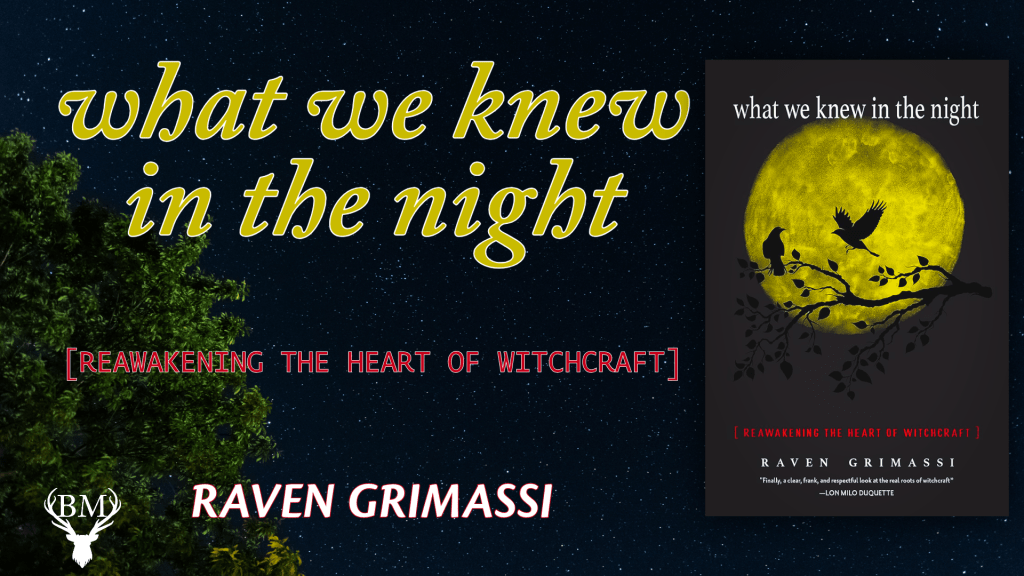
I’ve always appreciated Raven’s romanticism in his writing. He really has a way of pulling a reader in and letting them get lost in, well, the romance of magic, and regardless of one’s witchcraft path, his writing still continues to make us think, and it’s incredible that he can continue to do this even posthumously. In What We Knew in the Night, one of his more recent books published by Weiser, he strikes that inspirational chord early on with this:
“Here I look upon the same moon that did every Witch before me, and beneath which every invocation was spoken.” (Grimassi)
I have obviously looked up at the moon before and worked magic beneath it, but I looked up at again with newfound eyes after reading that passage and contemplating on the fact that my familial ancestors looked up at that moon and the ancestors of my magical tradition worked their spells and rituals beneath it too—it really does make you feel connected to something bigger.
I’m not one to usually say that I am set in my ways, but I know what I like when it comes to magic. I don’t generally read magical books to reinvent my entire magical practice. Instead, I read them to find new ways of thinking or a new technique or two that can nicely supplement my current magical regime. In this book, the practice is based on five key components. These components are gathering the virtue of the moon, meeting the wafting (which I interpret as sprowl or the virtue found in the Witch’s landscape), aligning the witch’s blade, creating the Witch’s pentacle, and making the Witch’s ring (as in a ring that you wear, which brings the quintessence to the command of the Witch.)
It was refreshing to see Raven spend so much time talking about the mythological and folkloric connection to nature. From an exploration of the ancient plant people of old Europe to the magical uses of the Mandrake, the not-so-well-known mythology of these is laid out beautifully. He also discussed the use of a turnip that has been stained black as the ‘Elevation of the Host’ at the Witch’s Sabbat, but perhaps this was Devil’s Turnip, or the so called English Mandrake, or Bryony.
I’ve always loved Raven’s writings on the magical worlds. Stepping beyond the concept of a Witch’s circle (which, let’s be real, has been discussed in oh so many books), we also find a good amount of lore about the astral dimension, the elemental plane, and even a concept referred to as the Shadow’s Edge, which is the first time I had ever heard reference to this being used magically. The shadow’s edge refers to that actual place where the light and dark meet, that line where one is stepping into the shadows of the forest and out of the safety of the light, it separates the esoteric from the exoteric. I can’t wait to explore this more in depth in my personal practice. (It’s currently 13 degrees, so I will not be venturing into the woods any time soon!) Although, he does provide an interesting way of using a shadow cast by candle and a statue of one’s gods.
The chapter on Old Magic was quite lovely. Not only are we given a selection of magical techniques which I haven’t seen before, such as using thorns in magic, techniques of using the Pentagram, ways of making offerings to the gods, passing magical power into an object, and working magic with the Witch’s cup, but the most unique sections here were the Watchers and the Sabbatic Meal. Like most books on the subject, the Watchers here are still left in a shroud of mystery, but ultimately are summarized as magical beings who watch over humanity, and the sabbat meal ritual offers a beautiful ‘sacrificial’ rite for hallowing the meal during ritual.
I will always have a special place in my heart for Raven Grimassi, and while I am so honored to play a part in preserving a good number of Raven’s titles through Crossed Crow, it’s equally fun to be able to enjoy his writing through other publishers, too!
About the Author
Raven Grimassi (1951-2019) wrote over 20 books on Wicca, Stregheria, witchcraft and neo-paganism. He popularized Stregheria, the religious practice of witchcraft with roots in Italy. Grimassi presented this material in the form of neo-paganism through his books. He had been a practitioner of witchcraft for over 45 years and was the co-director of the Ash, Birch and Willow tradition. He died of pancreatic cancer on March 10, 2019.
Book Information
- What We Knew In the Night by Raven Grimassi
- Publisher: Weiser
- Publication Date: August 2015
- Dimensions: 6×9
- Page Count: 272
- Purchase link
 Blake Malliway
Leave a comment