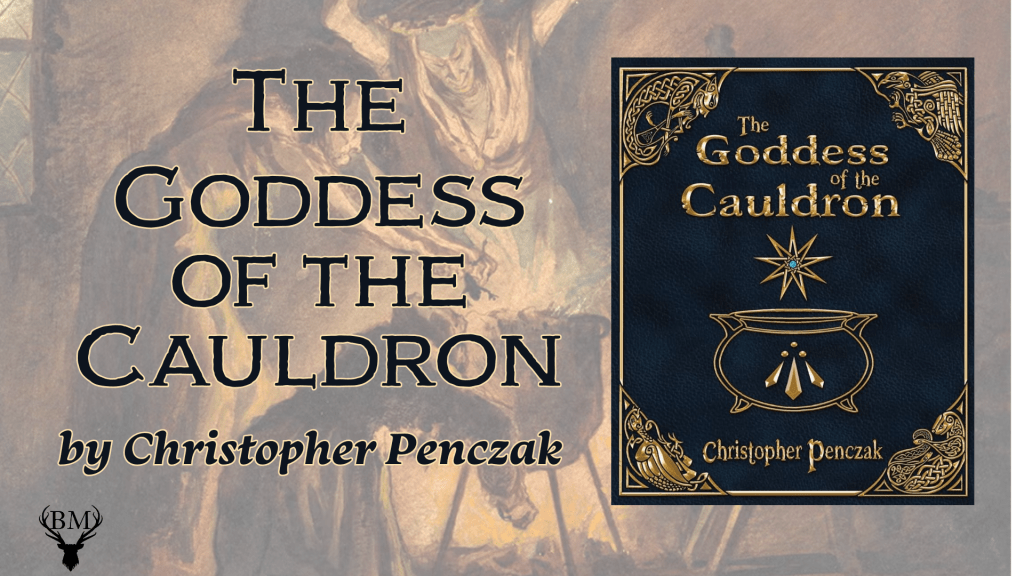
There has been an incredible influx of Christopher Penczak material lately. From the re-releases of the Temple of Witchcraft series through Llewellyn, the re-release of Gay Witchcraft through Red Wheel/Weiser, and, most recently, The Goddess of the Cauldron, a new work published through Copper Cauldron, his own publishing house, Penczak continues to be a trusted, reliable source of well-researched information and magical practice.
I had the pleasure of reading The Goddess of the Cauldron recently and found that this incredible tome is quite unlike other books on the market that focus on this topic. Rather than just offering another collection of simple spells and charms to perform with the cauldron as the focal point, this book puts a lot of emphasis on understanding the wider breadth of the myths surrounding the cauldron. Explorations of famous figures throughout mythology including the Dagda, Bran, Cerridwen, Ceres, and Medea are given alongside historical retellings of the Gundestrup Cauldron, the Holy Grail, and the Alchemical Crucible, to name a few. These narratives are packed nicely between some pretty hefty magical workings that go beyond simple spell casting.
Penczak discusses in great detail the manifestation of the ‘entirety of deity’ within the cauldron, which reinforces this tool’s significance as a focal point for magical and/or devotional work. He says:
Many [witchcraft ] traditions look at divinity as fivefold. The Goddess is triple in form. She is maiden, mother, crone, or goddess of the heavens, Earth, and underworld, or perhaps sky, land, and sea. Her triple nature is described in many ways, even as the Fates of past, present, and future. The three legs of most freestanding cauldrons represent her triple aspect. She gives support to creation, as creation is represented by the bowl of the cauldron. Without her, there is no universe. The handle of the cauldron connects in two points and forms an overarching bridge by which to grasp and carry the cauldron. The God is seen as dual, or double. (Penczak, p 28-29)
When looking at the cauldron with a divine lens like this, it’s easy to see how one might find it to be the perfect mixing pot (no pun intended) to represent the totality of the Witch’s divine.
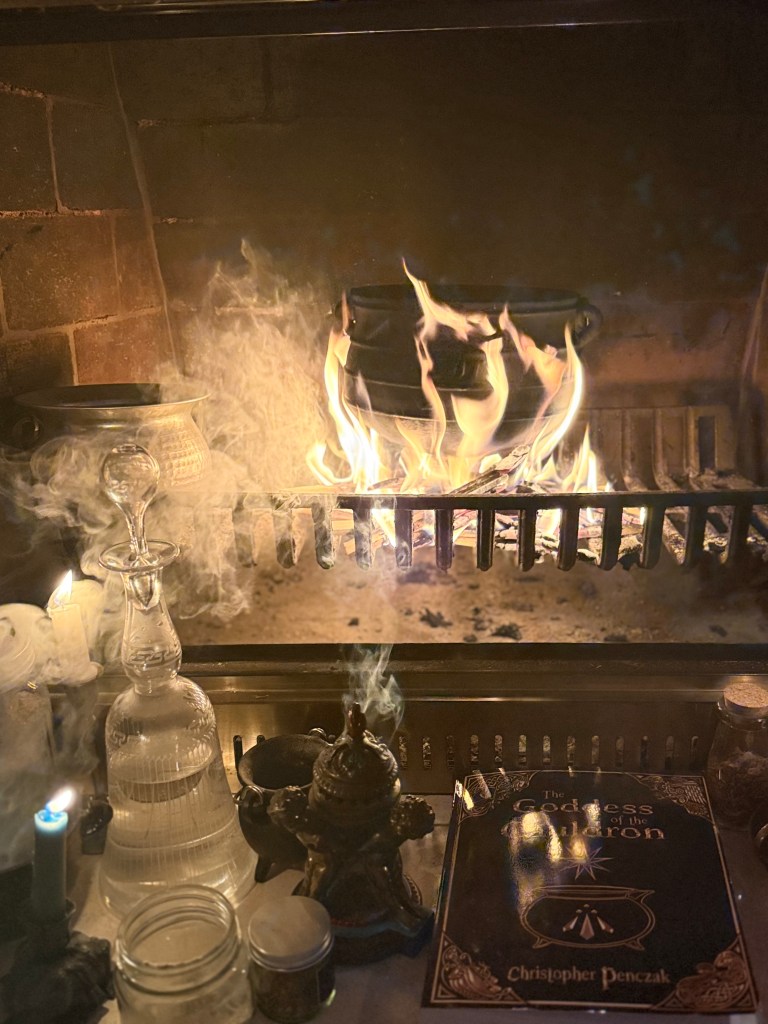
Moving on to Part 2 takes us to the more hands-on part of the book: Initiation from the Cauldron. This section places the reader in the shoes of Gwion Bach, Cerridwen’s servant who was tasked with stirring the brew in her cauldron, which, as mythology asserts, is the Brew of Awen. I outlined a portion of the ritual below, but it was so incredible to be able to actually sit in front of my fireplace with a giant cast iron cauldron set on the hearth and actually be able to brew a potion, just like all those Witches from television!
Perhaps one of the most thought provoking sections in part two is Christopher’s discussion on The Alchemy of Initiation, which relates the symbolism of the cauldron to spiritual transformation (initiation). Consider this excerpt:
Is this not the world of the cauldron? Separate things are brought together, the ingredients of the brew. They are joined together, dissolved in the waters of the cauldron and in the psychic sea of the initiate’s consciousness or the collective consciousness of the tradition. Then the best part is drawn off and purified, as the dregs like poison fall to the cauldron…. (p. 131)
As with all transformative, initiatory processes within the various magical traditions, nothing comes, nor should it be expected to, come easy. The same can be said with this book—the work is intensive, but rewarding. To effectively progress through the rest of the initiatory and transformative rituals outlined in the book takes more than just a few hours to work though, but the effort seems worth it. This truly is an entire system of witchcraft designed to carry a practitioner a lot farther than any other standard spellbook.
A Working from the Book: The Creation of the Brew
I spent the week ahead of time gathering all the herbs and ingredients needed to brew my potion, The Brew of Awen, and followed the book’s advice by setting up a magical space in which to brew it. I set my large cast iron cauldron over a fire in my fireplace, and prepared my ritual space, casting a circle around my living room using these words from the book:
By the Sacred Cauldron that dwells within the heart of Annwn, I cast this cauldron circle. I call upon the waves of creation to flow from within me, about me, and all around me. I call upon the powers of the cauldron to guard me from all harm. So mote it be.
After I felt the atmosphere shift, a sign that the circle’s edge had been raised sufficiently about me, I proceeded with the ritual, adding the water to the cauldron, and slowly contributing the other ingredients. I then proceeded with the pathworking to enter into the darkness of the cosmic cauldron.
About the Author
Christopher Penczak is an author, teacher, and healing practitioner. Rooted firmly in the traditions of modern Witchcraft, he draws from the timeless wisdom of many cultures in the creation of new techniques and traditions.
Christopher is the author of numerous books, including the award-winning six-volume Temple of Witchcraft series (Llewellyn) and the Three Rays of Witchcraft (Copper Cauldron Publishing). Other works include Ascension Magick, Instant Magick, and the Witch’s Shield (Llewellyn) and City Magick, Gay Witchcraft, and Spirit Allies (Red Wheel/Weiser). He has been a featured columnist for newWitch magazine and publications such as Genre, InnerSelf, and Kaleidoscope.
Christopher is a co-founder of the Temple of Witchcraft tradition and not-for-profit religious organization, and teaches and travels extensively teaching Witchcraft. He also offers a variety of online classes and lectures. For more visit http://www.christopherpenczak.com and http://www.templeofwitchcraft.org.
Book Information
- The Goddess of the Cauldron by Christopher Penczak
- Publisher: Copper Cauldron
- Publication Date: September 1, 2025
- Dimensions: 7.5X9.5
- Page Count: 374
- Purchase link.


Leave a Reply