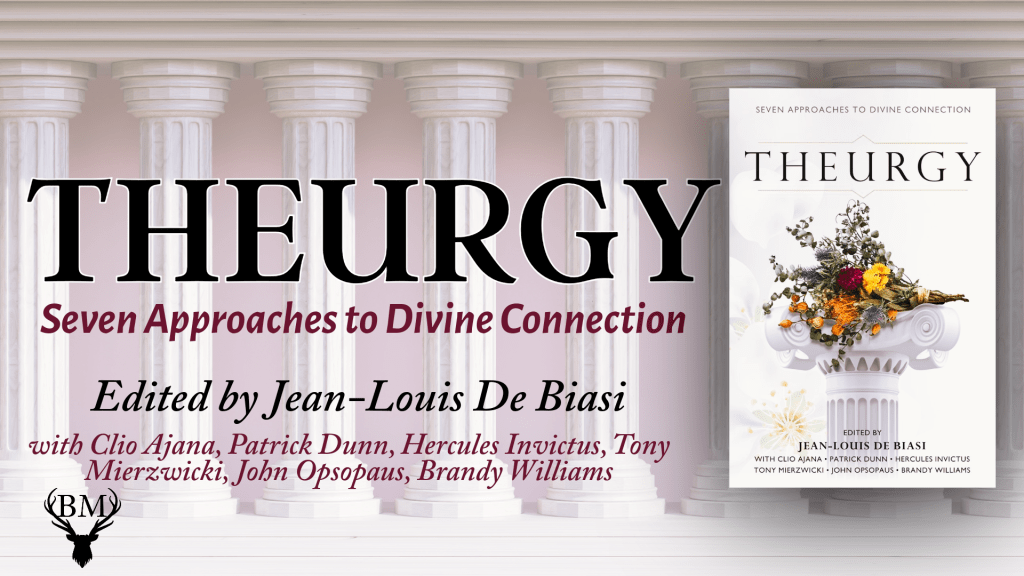
This book turned up for me at just the right time. I’ve recently begun an intensive and immersive exploration of the Goddess of the Witches and have been working to align my personal practice more closely with her, and in pursuing this, the themes of magical theurgy were bound to pop up at one point or another. Theurgy: Seven Approaches to Divine Connection is actually an anthology bringing together several voices from actual Theurgists, each of who offers their own unique take on how to incorporate theuristic (is that a word?) techniques into one’s magical practice.
The first contribution, by John Opsopaus, PhD, discusses the magical process of sustasis, which, as he indicates, is a meeting between a person and a god. While the author does offer an entire ‘sustasis ritual’ to perform to meet the goddess Athena, he does say that it could very easily be adapted to fit nicely into one’s personal practice. More on that later though. For me, the most valuable part here was the very detailed instructions for writing a poetic, evocative, and effective invocation to your deities, something I haven’t seen articulated this well in any other book. While I won’t go into the specifics of my personal ritual, I would like to share a version the invocation that I wrote using this instructions Opsopaus provided:
O most glorious Queen of the Witches, Goddess of the starry heavens whose heartbeat can be felt in each ray of silver’d moonlight, Hear me, hear me! Hear my voice as it echos through the heavens, and I pray you let your warmth and guiding light fill me. Descend upon this circle. She who is the consort of the Horned One of the Morning Light, She who is the Mother of All Witches, She whose name is MYSTERY, I call on you to descend upon this the land which yearns for your Love. Without you, I am alone. Without you, I am forsaken. Without you, I have naught. You who are the light of the heavens, hear me as I speak your secret name…[x]…and let me know the beauty of your blessings and feel the joy and terror of your presence. O, Goddess of the Witches, come.
While my actual invocation is something I am not super comfortable with sharing publicly here, hopefully the sentiment is there. This was a fantastic exercise to work through though, and is certainly one I think any Witch who works with deities should work through. Worst case is you write a beautiful invocation for your chosen deity! I’m sure they’d love that.
The second article by Hercules Invictus, discusses the role of the iconostasi, or icon stand. This is exactly what it sounds like—a dedicated space in the home where you ‘visit’ with your gods. Like the ancient Greek temples, the icon stand in your home is a sacred place where devotions, prayers, and offerings, are all made to the gods. If you already work with gods in your practice, like I do, you might already have a place in your home where you come to do this type of work. In my case, it was a good reminder to freshen it up, add some flowers, replenish the candles and, you know, give it new ‘life’ again. Once this is set up, you can petition the gods for guidance, take on the qualities of the gods, and journey to meet them.
The third article is by Brandy Williams, and discusses carrying the deities in modern magical practice. Carrying, in this sense, refers to the specific deity actually filling a receiver, usually a person. Three different stages of carrying are discussed here: 1) Participation, where the theurgist acts in common with the god. 2) Communion: the deity possesses the theurgist, and 3) Union, where the theirgust actually becomes the deity. Most of this article was written through the lens of ceremonial magical traditions as opposed to Witchcraft, but it was pretty easy to draw comparisons between the two, if you happen to be a Witch reading it. While possessory work is a crucial part of many magical traditions, I think the most important takeaway from this article was the author’s suggestion to engage in ‘daily sitting’ with the deity—spending time to sit before their shrine and engage with them. Perhaps we can all be a little better at doing that regularly.
Next, we have Patrick Dunn’s article on Theurgic Meditation and Contemplation. I admittedly used to be one of those people— “I can’t meditate…my mind is just too active,” I’d say. In recent years I have gotten better at this though and have dismissed some of these untrue notions regarding meditation and magical contemplation. Dunn reminds us that meditation is not a stilling of the mind, or an emptying of it, but just allowing the mind to do what it does best: think. While some of the earlier exercises in his essay encourage the reader to allow the mind to just wander, the later contemplative exercises encourage us to be mindful of those things which are more akin to the divine. Meditations on beauty, the view from above, and various divine virtues are all designed to create a more thorough and authentic self, which paves the way for one to experience theurgy more effectively.
The next essay, Immortal Theurgy, by Jean-Louis de Biasi, contributes quite a bit to the body of this work, but for me, the most interesting parts was the discussion of initiation into a theurgic tradition, the goals of which are to awaken one’s inner abilities, to teach safe and effective methods of raising the Divine, and lastly to teach what you will find after death. In exploring these three goals, de Biasi offers a comprehensive deep dive of the Eightfold Theurgic Path which highlights the eight keys one must master to practice theurgy effectively. These are mindfulness, breathwork/sacred sounds, calisthenics, devotion, energy healing, philosophy, astrology, and theurgic rituals.
Theurgy: An Intimate Path to the Gods by Clio Ajana provides a well-structured way for a Witch, magician, or theurgist to really incorporate daily theurgy into their lives. The exercises wonderful: Deity of the Day, Prayer Circle for Deity of the Day, Magical Journal Review with Deity, Remapping the Constellation, Crafting with Planetary Hours, Use of Numerological Calculations, all of these wonderful techniques in the spirit of engaging more with theurgy in daily practice.
Tony Mierzwicki’s essay is about the incorporation of Qabala into theurgy—this was a lot to dissect, but I imagine those practitioners who have experience in the Qabala would find this part integrates nicely into their practice. Tony gives us a deep dive into each sefirot on the Tree of Life and how each one relates to a different aspect of the Divine, with a ritual to be performed at each sphere.
As I continue to work though my getting to know the Goddess of the Witches in my own practice, I found the techniques presented in Theurgy to be a welcome addition to my personal toolkit of magical techniques. I will certainly be revisiting this time time and time again.
About the Author
Jean-Louis de Biasi is an author, lecturer, and philosopher. He has been initiated into the highest degrees of several Western traditions. Jean-Louis teaches the eight rays of Mediterranean yoga all over the world. he and this anthology’s other contributors participate in a panel about theurgy on Hercules Invictus’s podcast, Voice of Olympus.
Book Information
- Theurgy edited by Jean-Louis de Biasi
- Publisher: Llewellyn
- Publication Date: November 8, 2025
- Dimensions: 6×9
- Page Count: 256
- Purchase link.

 Blake Malliway
Leave a reply to The Practical Art of Divine Magic – Blake Malliway Cancel reply